More than any other year, CES exhibitors had front doors top-of-mind, with a wide variety of companies making product introductions and announcements in the smart lock market that not only tout technological advances like battery charging, power generation, biometric expansion, and more, but also new ways for security pros to penetrate hot verticals such as multifamily, property management, and high-end residential.
Several locks were featured by the Z-Wave Alliance, which recently introduced the new Z-Wave User Credential Command Class (CC) — a key part of the Z-Wave protocol that standardizes how smart locks and security systems manage and communicate different user access methods, such as fingerprints, PINs, and passwords, enabling secure, interoperable access control and advanced automation, such as unlocking a door and disarming an alarm simultaneously with a fingerprint.
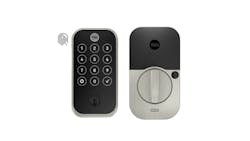
Yale and ADT displayed the Yale Assure Lock 2 Touch with Z-Wave 800 Series, which was the first-ever Z-Wave Credential Command Class smart lock (first introduced in April 2025). The lock features fingerprint access and integrates with ADT’s connected security ecosystem through the ADT Base hub. The ADT+ app enables remote management of the lock, system arming and disarming, and control of other Z-Wave devices.
The Yale smart lock also includes Z-Wave Long Range (ZWLR) readiness for extended communication range — about 1.5 miles line of sight in ideal conditions — and improved signal reliability. This means devices far from a hub can stay connected without relying on repeaters.
Z-Wave Alliance chair Avi Rosenthal also pointed out another addition to the protocol around batteryless technology. “We altered our branch of Z-Wave to take advantage of batteryless technology,” Rosenthal said. “Sleeping devices are really difficult to deal with from an RF perspective, because RF networks like to check in on devices on a regular basis so that they know they’re still alive. If the only time you activate a device is when it is touched, moved, or activated, the network throws it away because they think it’s a dead node. We fixed that problem. Our system now recognizes when you are using a batteryless technology and actually enables that node to be sleepy on the network and not check in on a regular basis.”
WePower Technologies (recently renamed Gemns) and Southco demonstrated this batteryless technology and protocol at CES as well. The kinetic energy harvesting technology for electronic locks generates electrical power from the mechanical energy of normal door operation, converting the physical motion of opening and closing the door into stored electricity. The harvested energy charges a rechargeable battery that powers the electronic lock components, potentially eliminating the need for battery replacement over the lock’s lifetime.
The company demonstrated integration of this energy harvesting system in electronic access control hardware — namely a Southco lock — showing how the technology can be incorporated into existing lock form factors.